
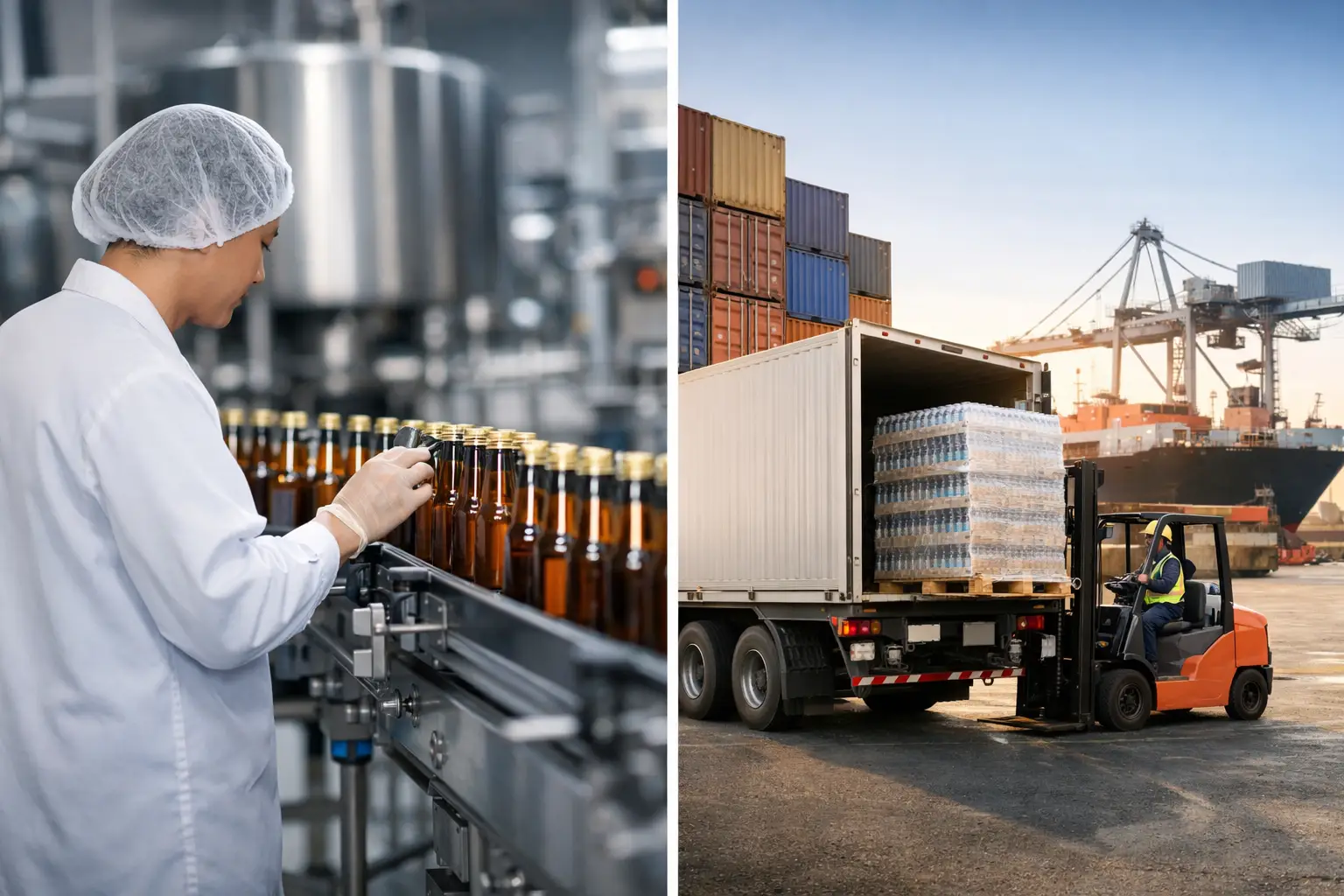
A beverage brand usually reaches this decision sooner than expected. Demand picks up, retailer conversations get serious, and the same question moves from theory to operating risk: should you choose in house versus outsourced beverage production?
For founders, procurement teams, and commercial buyers, this is not just a cost discussion. It affects formulation control, speed to market, compliance, capital allocation, and the ability to scale without weakening the product. The right model depends on what you are making, how fast you need to grow, and how much operational complexity your business is built to absorb.
In house versus outsourced beverage production: what changes
The difference is straightforward on paper. In-house production means the brand owns or directly operates the facility, equipment, labor planning, quality systems, and production schedule. Outsourced production means a contract manufacturer produces the beverage to the brand’s specifications under agreed commercial and technical terms.
In practice, the gap is wider than ownership. It changes who carries execution risk day to day. It also changes how quickly a brand can move from formulation to finished goods, how much flexibility it has during demand swings, and how much working capital stays available for sales, trade support, and market expansion.
For natural and functional beverages, the stakes are higher. Products built on real ingredients often involve more complexity around sourcing, shelf life, flavor consistency, and processing. A manufacturing decision that looks efficient on a spreadsheet can create quality drift if the operating environment is not disciplined.
When in-house production makes sense
In-house manufacturing can be the right move when production itself is a strategic asset, not just a necessary function. If a company has stable volume, long-term demand visibility, and the capital to invest in specialized equipment, owning production can improve control and margin over time.
This model gives brands direct oversight of batching, filling, quality assurance, sanitation, and changeovers. That matters when a formula is technically sensitive or when a product’s market position depends on precise execution. If a beverage contains active ingredients, natural extracts, or a clean-label profile that leaves little room for variation, direct process control can be valuable.
There is also a stronger case for in-house production when a company runs a narrow product portfolio at meaningful volume. Repetition improves efficiency. Equipment utilization rises. Production planning gets cleaner. Over time, fixed costs can become easier to justify.
But the trade-off is significant. Building or operating a beverage facility requires more than tanks and fillers. It requires technical leadership, preventive maintenance, regulatory discipline, vendor management, inventory planning, and the ability to recover quickly when something goes wrong. A plant can improve control, but it can also create a constant demand for capital and management attention.
Where outsourced beverage production wins
Outsourced manufacturing is often the faster and more practical route, especially for emerging brands and for established companies testing new concepts. It removes the need for large upfront capital spending and gives the business access to production infrastructure that already exists.
That changes the economics of growth. Instead of tying cash up in equipment, permitting, staffing, and facility overhead, brands can invest in customer acquisition, market development, and product refinement. For many businesses, that is the difference between launching a product and delaying it.
Outsourcing also reduces operational friction. A capable manufacturing partner already has quality systems, sourcing networks, production teams, packaging knowledge, and regulatory experience in place. That can shorten the path from approved formula to commercial run.
This matters even more when scale is uncertain. If demand rises quickly, a strong outsourced partner can often absorb higher volume faster than a single brand-owned facility. If demand is uneven, the brand avoids carrying the full burden of underused assets.
For companies entering multiple channels or regions, outsourced production can also support supply flexibility. A partner with broader manufacturing reach can help reduce freight inefficiencies, improve service levels, and create backup options when one market faces disruption.
The real decision is not cost alone
Many teams start with a simple question: which model is cheaper? That is rarely the right starting point.
In-house production may appear less expensive on a per-unit basis once volume is high enough, but that view often ignores the full cost of utilization risk, downtime, staffing, maintenance, audits, and working capital tied up in raw materials and finished goods. Outsourced production may carry a visible manufacturing fee, yet it can still produce stronger business economics if it reduces waste, accelerates launch timing, and protects capital.
The better question is this: which model creates the best total operating outcome for the stage your brand is in now?
A company shipping a few regional SKUs has very different needs from a business supplying national retail, foodservice, and export channels. Cost per case matters, but so do minimum runs, scheduling flexibility, packaging compatibility, quality consistency, and the ability to maintain service levels during demand spikes.
Quality control is where the model gets tested
In beverage, quality is not a marketing claim. It is an operating discipline. That is where in house versus outsourced beverage production becomes a more serious decision.
With in-house production, quality control sits inside your walls. You define the systems, train the team, manage documentation, and respond directly to deviations. That can be a strength if your organization has the technical depth to support it.
With outsourcing, quality depends on partner selection and process alignment. A strong contract manufacturer should be able to document specifications clearly, validate processes, manage traceability, and maintain consistent execution across runs. If those systems are weak, the brand pays for it through product inconsistency, delays, and customer risk.
This is why the best outsourcing relationships are not transactional. They are built around shared standards. Ingredient handling, formula integrity, packaging performance, micro controls, and release procedures all need to be defined with precision. Quality does not improve simply because production is external. It improves when the external partner is disciplined enough to protect the product without compromise.
Speed to market often favors outsourcing
Brands launching a new beverage rarely have unlimited time. Shelf opportunities close. Seasonal windows pass. Competitive pressure builds fast.
Outsourced production usually offers a speed advantage because the infrastructure is already in place. The right partner can support formulation refinement, pilot runs, scale-up planning, packaging selection, and commercial production without waiting for a facility buildout or equipment installation.
That speed can be decisive in categories like functional energy, sports hydration, and modern cocktail formats, where demand shifts quickly and packaging trends change fast. Moving first with a high-quality product is often more valuable than owning every step of production from day one.
That said, speed only helps if the partner can execute repeatedly. Fast onboarding means little if lead times become unstable once orders increase.
Capacity, flexibility, and geographic reach
Supply chains are more fragile than they look during a stable quarter. Ingredient volatility, freight disruption, packaging shortages, and regional demand shifts all test manufacturing models.
An in-house plant gives a company direct authority over capacity planning, but it also concentrates risk. If that site goes down or reaches its limit, options narrow quickly.
An outsourced network can create more resilience, particularly when the manufacturing partner has multi-region capability. Production flexibility across geographies can reduce single-site dependence, improve service into different markets, and give brands a more practical path to international growth. That is especially relevant for businesses that need both premium product standards and meaningful output volume.
What brands should ask before choosing
The right answer usually becomes clear when a brand stops asking, “What would we prefer to own?” and starts asking, “What must we control ourselves, and what can a qualified partner execute better?”
If your brand has the capital, operating expertise, and stable demand needed to keep assets productive, in-house manufacturing may support long-term control. If your business needs speed, flexibility, and lower capital exposure, outsourcing is often the stronger commercial decision.
The best operators stay honest about their current stage. They do not build manufacturing for status. They build or partner for performance.
For many beverage companies, the strongest path is not ideological. It is practical. Control what defines the brand, protect quality at every stage, and choose the production model that supports growth without compromise. UNC One Corp. operates from that standard because real ingredients, real results, and reliable scale only matter when execution holds up under pressure.
The right production model is the one that keeps your beverage consistent, your supply dependable, and your business free to grow at the pace your market demands.

No responses yet