
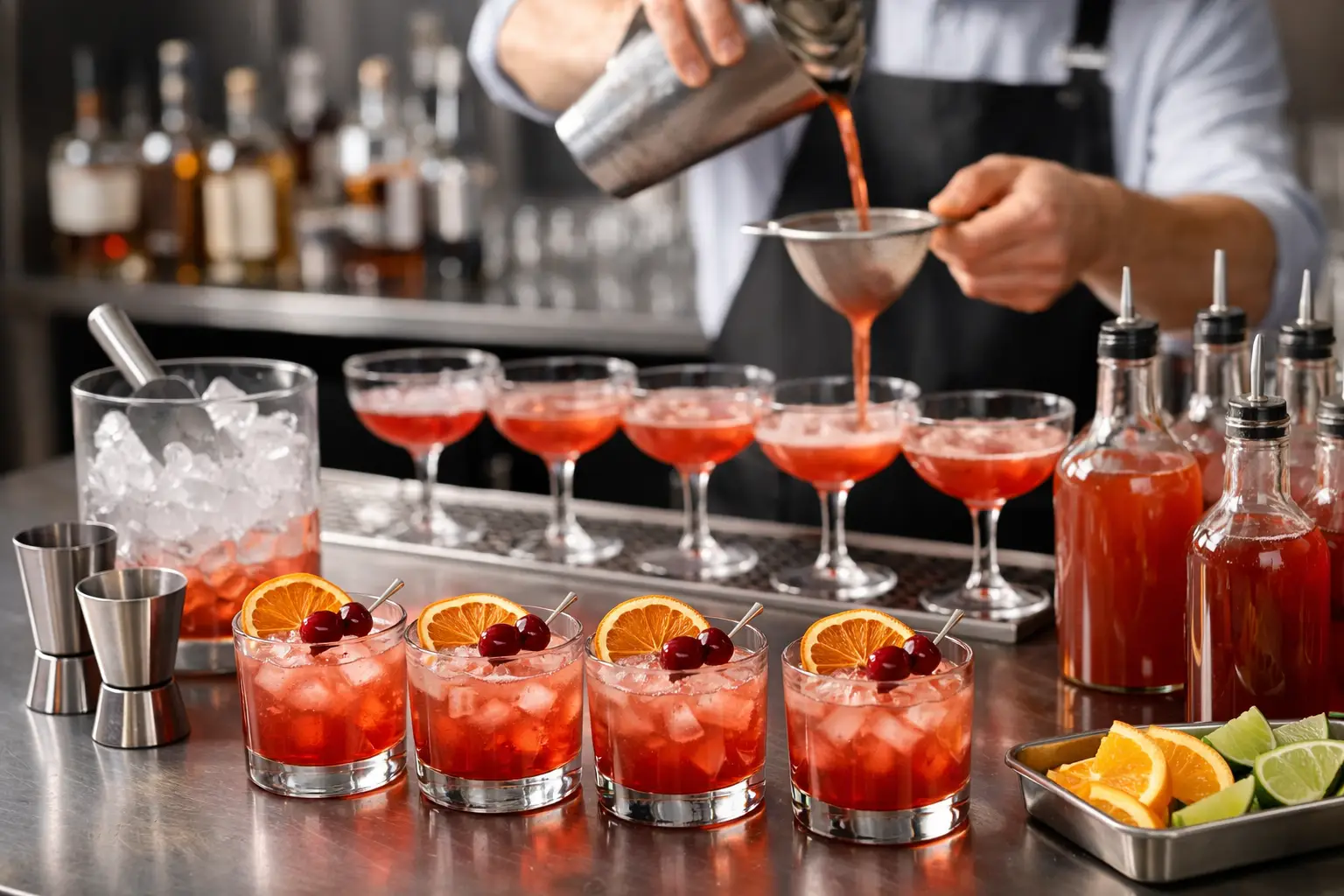
A cocktail that performs in a test kitchen can fail fast on a commercial line. Citrus behaves differently at volume. Natural flavors can shift under heat. Sugar, acid, and alcohol that feel balanced in a small batch may separate, dull, or lose aroma once the product moves through filling, pasteurization, and distribution. That is the real challenge in how to scale cocktail production – protecting product character while building a process that can hold up under commercial demand.
For beverage brands, hospitality groups, and channel partners, scale is not just a capacity question. It is a systems question. The brands that grow successfully do not simply make more product. They build a repeatable manufacturing model that preserves taste, meets compliance requirements, supports shelf stability, and stays efficient across multiple markets.
How to scale cocktail production without losing quality
The first mistake is assuming the original recipe is ready for industrial production. In most cases, it is not. A benchtop formula is designed for flavor discovery. A production formula must be designed for flavor, process tolerance, ingredient variability, packaging compatibility, and regulatory compliance.
That means every core input needs to be evaluated under real manufacturing conditions. Juice concentrates, natural extracts, sweeteners, botanicals, colors, and alcohol bases all respond differently once they are exposed to larger tanks, pump shear, thermal treatment, and oxygen pickup. If the drink is positioned as all-natural or clean label, that margin for error gets tighter. You do not have synthetic stabilizers to hide process weaknesses.
This is why scale-up starts with formulation discipline. Before production expands, the formula should be stress-tested for pH, brix, alcohol level, flavor retention, emulsion stability, and microbiological risk. Ingredient substitutions also need to be mapped early. A cocktail that depends on one niche botanical supplier may look strong on paper and become fragile in market reality.
Start with process, not just volume
Buyers often ask about line speed first. It is a fair question, but it is rarely the most important one at the beginning. The better question is whether the process can reproduce the same drink every run.
Commercial cocktail production depends on process control. That includes batching sequence, mix times, agitation levels, filtration requirements, temperature management, and fill accuracy. A product with fruit components may require a different handling profile than a spirit-forward sparkling cocktail. A still product in glass has different production demands than a carbonated format in sleek cans.
When brands skip this step, quality drift shows up quickly. One batch tastes bright, the next tastes flat. Sediment increases. Carbonation misses target. Fill weights vary. These are not small operational issues. They become customer complaints, retailer friction, and margin loss.
A serious scale plan treats SOPs as part of the product itself. The drink is not just the ingredient list. It is the ingredient list plus the exact method used to produce it consistently.
Pilot runs reveal the real problems
Pilot production is where assumptions get tested. It shows whether a formula behaves on equipment that resembles commercial conditions and whether the product remains stable after packaging.
This is the stage to evaluate flavor hold, carbonation retention, dissolved oxygen, package performance, and shelf-life behavior. It is also where processing choices become clearer. Some cocktails can tolerate hot fill or tunnel pasteurization. Others require a different path to protect volatile flavor notes or maintain a fresher sensory profile.
There is always a trade-off. More processing can support safety and shelf life, but it may reduce top-note freshness. Less intervention may preserve flavor better, but it can narrow distribution flexibility. The right answer depends on channel, package type, target shelf life, and ingredient system.
Ingredient strategy determines whether scale is durable
If the product is built on real ingredients, scale needs a stronger supply strategy from day one. Natural cocktail production is less forgiving than many founders expect. Crop variation affects taste, color, and acidity. Regional sourcing changes lead time and cost. Alcohol sourcing can also shift based on geography, regulation, and availability.
A scalable cocktail platform uses approved ingredient specifications, backup sources, and defined quality tolerances. That does not mean lowering standards. It means documenting them. If lime concentrate is central to the profile, the acceptable acid range, aroma profile, and color target should be clear before purchasing expands.
This matters even more for multi-market growth. A formula intended for the US, Latin America, and Asia may need sourcing flexibility without changing brand identity. Manufacturing reach only becomes an advantage when the product can be reproduced with discipline across regions.
Packaging choices can help or hurt scale
Packaging is often treated as a branding decision first. In commercial production, it is also a technical and financial decision.
Glass can support premium positioning, but it adds freight weight, breakage risk, and line constraints. Cans improve logistics and speed, but acidic or alcohol-containing products may require careful lining compatibility review. Carbonated cocktails bring another layer of complexity because pressure performance, seam integrity, and temperature exposure all affect final quality.
Secondary packaging matters too. Tray formats, case configuration, pallet efficiency, and display requirements influence freight cost and warehouse throughput. If a cocktail is expected to move in both on-premise and off-premise channels, the package strategy needs to reflect those different operating realities.
In practice, the best packaging decision is the one that protects the product, fits the route to market, and supports margin at scale. Premium should still be practical.
Compliance has to be built into the production model
Anyone learning how to scale cocktail production quickly finds that regulatory complexity rises with every market entered and every claim added to the label. Alcohol beverages require attention to formula review, labeling, tax classification, and market-specific approvals. Add clean-label positioning, natural claims, or functional ingredients, and scrutiny increases further.
This is where many growth plans stall. The product is ready, demand exists, but the documentation and compliance systems are not in place. That delay is expensive.
Scalable operations treat compliance as a production function, not a last-minute legal task. Specifications, batch records, ingredient documentation, allergen controls, traceability, and finished-goods testing all need to be organized early. The more disciplined the system, the easier it is to expand into new channels without recreating the process each time.
Quality assurance must scale with output
A plant can produce high volume and still damage a premium brand if the QA framework is weak. As output increases, the cost of inconsistency rises. One issue affects more pallets, more distributors, and more accounts.
Quality assurance at scale needs in-process checks and finished-goods validation, but it also needs supplier qualification, retained samples, and complaint-response discipline. For natural cocktails, sensory review remains critical. Lab data matters, but so does whether the drink still tastes like the brand promise.
This is one reason experienced manufacturing partners matter. High-speed production only creates value when quality systems are strong enough to protect product identity at that speed.
Capacity should match demand patterns, not just forecasts
Scaling too late creates missed sales. Scaling too early can create aged inventory, cash pressure, and waste. The right capacity plan sits between those extremes.
Cocktail brands often deal with sharp seasonality, promotional swings, and account-specific demand spikes. A summer ready-to-drink format may surge fast, then soften. A national chain launch can change production needs overnight. Forecasting should account for these patterns, but production planning must also leave room for actual market behavior.
This is where flexible manufacturing has a clear advantage. The ability to run different batch sizes, support multiple packaging formats, or shift production across regions reduces risk. It gives brands and buyers more room to respond without compromising service levels.
For companies that want to grow without building their own plant network, a manufacturing partner with international production capacity can offer a practical path. UNC One Corp. operates with that kind of production flexibility, which matters when supply continuity is part of the commercial promise.
Scale works when the product and the operation are built together
There is no single formula for how to scale cocktail production because product type, distribution model, and brand position all change the answer. A clean-label premium margarita for retail has different manufacturing priorities than a sparkling vodka cocktail for stadiums or a private-label line for convenience. But the pattern is consistent. Brands scale well when they align formulation, process, packaging, compliance, and supply before demand exposes the weak points.
That is the real standard. Not more cases at any cost, but more cases with the same quality, the same trust, and the same product integrity that earned the first order. When scale is built that way, growth does not dilute the brand. It proves it.

No responses yet