
Packaging is no longer a secondary purchasing decision. For beverage brands, sustainable beverage packaging solutions must now protect flavor, support shelf life, meet retailer requirements, withstand distribution, and make a credible environmental claim. A package that looks responsible but fails on the filling line or arrives damaged does not serve the brand, the buyer, or the consumer.
The right decision starts with product reality. Carbonated cocktails, still functional drinks, sports beverages, and energy products place different demands on containers, closures, labels, and secondary packaging. Sustainability has to work within those demands. The objective is not simply to use less material. It is to build a package system that delivers product integrity, operational reliability, and a clear path for recovery after use.
Sustainable Beverage Packaging Solutions Start With Performance
A beverage package has one non-negotiable job: preserve the product. Oxygen exposure, light transmission, carbonation loss, migration risk, seal failure, and temperature variation can all affect quality. For natural beverages made with real ingredients, these risks deserve particular attention. A shorter or cleaner ingredient statement does not reduce the need for disciplined package testing.
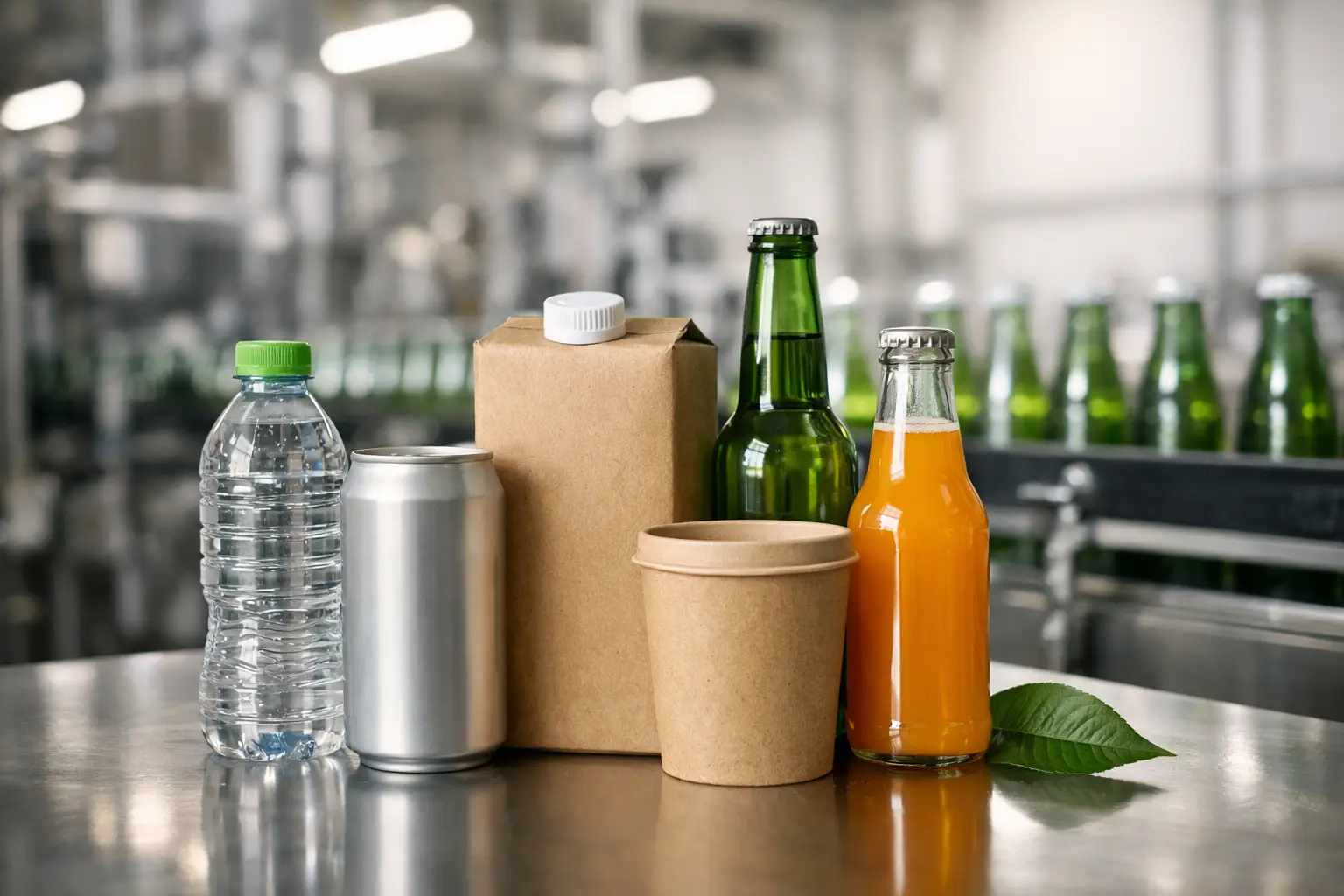
Aluminum cans, glass bottles, PET bottles, and cartons can each be a responsible choice in the right application. The best material depends on the formula, target channel, pack size, logistics model, local collection infrastructure, and expected consumer use. Brands should resist single-material thinking. “Sustainable” is not a performance category on its own.
For example, aluminum cans offer strong light protection, low weight, high filling-line efficiency, and established recycling value in many markets. They are well suited to carbonated drinks and single-serve formats. Their trade-off is that recycled content availability, can supply, decoration requirements, and regional recovery rates all affect the total result.
Glass supports premium presentation, product visibility, and a long-established recycling model. It can be particularly effective in hospitality, specialty retail, and returnable systems. However, glass is heavier, more breakable, and more energy-intensive to transport over long distances. A bottle that performs well in a local return loop may be a weaker choice for broad export distribution.
PET remains relevant for many beverage applications because it is lightweight, shatter-resistant, and efficient for high-volume distribution. Increasing recycled PET content can reduce reliance on virgin resin, but brands must plan for food-grade material availability, color choices, label compatibility, and market-specific recycled-content regulations. Clear PET generally supports stronger recycling outcomes than heavily colored or complex formats.
Match the Package to the Beverage and Channel
The package should be specified after the product and route to market are understood, not before. A premium all-natural cocktail for on-premise service has different needs than a functional energy beverage designed for convenience retail, gyms, and e-commerce fulfillment. Treating both products the same can create avoidable cost, quality, and waste.
Product Protection Comes First
Carbonated products require container strength, reliable seams or closures, and controls for carbon dioxide retention. Acidic beverages may require compatibility testing with liners, caps, and label adhesives. Products with natural colors, vitamins, botanicals, or sensitive flavors may need better light protection and oxygen management.
Shelf-life validation should include real production conditions, not only laboratory assumptions. Teams should test package performance across expected storage temperatures, shipping environments, and warehouse dwell times. The lowest-material package is not the right choice if it raises spoilage, returns, or quality claims. Product waste carries a material and commercial cost of its own.
Distribution Determines Material Efficiency
A package must move efficiently through the supply chain. Weight, pallet pattern, case configuration, cube utilization, breakage exposure, and automated handling all matter. High-speed production only creates value when the package runs consistently from filling through final delivery.
For national and international distribution, lightweight formats can reduce freight weight and improve pallet efficiency. For local hospitality networks, durable refillable glass may be commercially viable. The key is to calculate the full operating picture rather than making a decision based on a single sustainability attribute.
Consumer Use Shapes Recovery
Consumers cannot recycle what local systems do not accept or cannot easily identify. A well-designed package should make disposal guidance clear, practical, and consistent with the markets where it is sold. Claims need the same discipline as ingredients and nutrition statements. Broad language such as “eco-friendly” may be difficult to substantiate and can create unnecessary compliance risk.
Design choices matter. Full-body shrink sleeves, dark pigments, mixed-material components, metallic labels, and difficult-to-remove adhesives can complicate sorting or recycling. These features may have visual appeal, but brands should assess whether the branding benefit justifies the recovery challenge. Often, a cleaner package architecture improves both recyclability and shelf presence.
Design the Entire Packaging System
Primary packaging receives most of the attention, but it is only one part of the system. Closures, labels, multipacks, trays, corrugated cases, dividers, stretch wrap, and pallets all affect material use and distribution performance. A packaging review should identify where components can be reduced, standardized, or redesigned without compromising safety.
Lightweighting can be effective when it is engineered rather than guessed. Reducing bottle or can weight may lower material consumption and freight impact, but excessive reduction can lead to denting, paneling, instability, or line issues. Changes should be validated at production speed and through transportation testing. Quality without compromise means proving that a lighter format still protects the product.
Secondary packaging is often a direct opportunity. Right-sized cases can improve pallet density and reduce corrugated material. Replacing unnecessary inserts, optimizing tray designs, or selecting recycled-content corrugate can improve efficiency. At the same time, retail-ready packaging must remain easy for store teams to open, stock, and display. A case that saves material but creates labor friction may lose acceptance at the account level.
Multipacks require special attention. Plastic rings, shrink film, paper wraps, paperboard clips, and fully enclosed cartons each have different material, equipment, cost, and shopper implications. The right format depends on pack weight, retail handling, moisture exposure, merchandising requirements, and available machinery. There is no universal winner.
Build Sustainability Into Manufacturing Decisions
Sustainable packaging is a supply-chain program, not a graphics exercise. It requires early coordination among product development, procurement, operations, quality, regulatory teams, and commercial partners. Decisions made late in the process can force expensive tooling changes, disrupt production schedules, or limit material sourcing options.
For emerging brands, the practical question is whether a packaging concept can be produced consistently at commercial scale. A custom bottle may strengthen differentiation, but it can also create longer lead times, higher minimum order quantities, limited supplier flexibility, and more complex line changeovers. Stock formats may provide faster entry and lower risk, especially during early market validation.
Contract manufacturing partners should be evaluated on more than filling capacity. They need experience with the chosen format, access to qualified packaging suppliers, quality systems for incoming material controls, and the ability to run the package at target speeds. They should also be able to identify whether a sustainability change will affect carbonation, torque, seam integrity, coding, label application, case packing, or pallet stability.
UNC One Corp. approaches packaging as part of product execution: real ingredients, reliable process control, and scalable production must work together. For brands moving from concept to distribution, that integrated view helps prevent a package decision from becoming a production constraint.
Measure Claims With the Same Discipline as Quality
A credible sustainability strategy needs measurable criteria. Recycled content percentage, total package weight, recycled-material sourcing, recyclability by target market, shipment efficiency, and product-loss rates are useful indicators. The right set will vary by product and geography, but each should be traceable to supplier documentation and actual operating data.
Lifecycle assessments can help compare options, but they should be interpreted carefully. Results depend on assumptions about energy sources, transport distances, reuse cycles, recycling rates, and end-of-life treatment. A study is valuable when it informs a specific decision, not when it is used to support a broad claim without context.
Regulatory requirements also continue to evolve. Extended producer responsibility programs, recycled-content mandates, labeling rules, deposit systems, and packaging taxes differ by jurisdiction. Brands selling across markets should build compliance review into package development from the start. A design that is efficient in one country may require modification in another.
The strongest packaging programs are iterative. Start with a format that protects the beverage, runs reliably, and fits the intended market. Measure its performance. Then improve material use, recovery compatibility, and supply resilience with each production cycle. That approach gives buyers confidence, protects product standards, and gives brands room to grow without rebuilding their packaging strategy at every stage.

No responses yet