
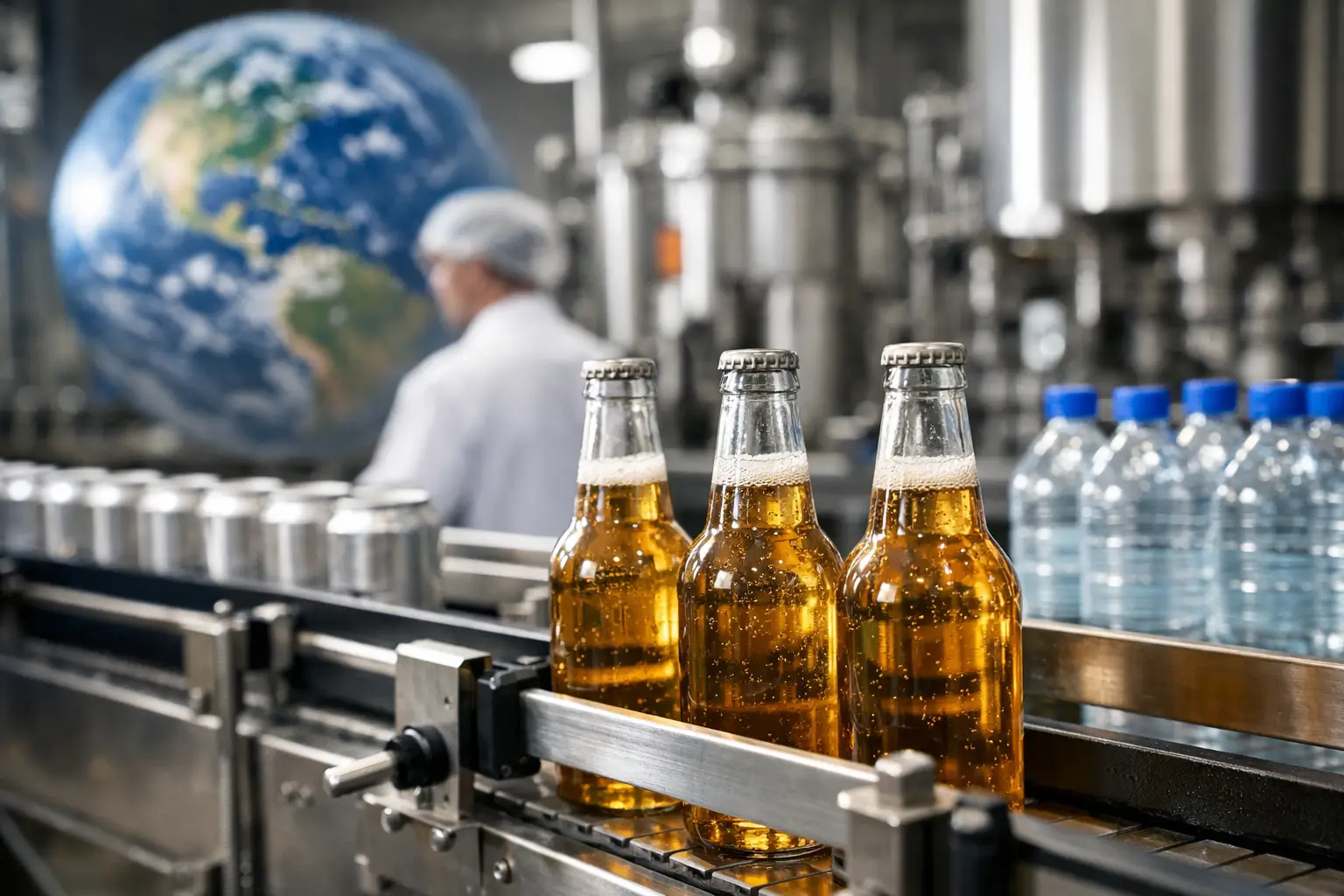
A beverage can win on taste in a buyer presentation and still fail at launch because the formula cannot hold color, flavor, carbonation, or margins at commercial scale. That is why global beverage manufacturing trends matter to more than product developers. They affect procurement decisions, distribution reliability, retail readiness, and the ability to protect a brand promise in every market.
For beverage brands and channel partners, the strongest trend is not novelty for its own sake. It is the move toward products that are cleaner, more functional, operationally repeatable, and available at the volumes the market requires. Real ingredients still need real manufacturing discipline.
Global Beverage Manufacturing Trends Shaping Demand
Clean labels are becoming a production standard
Consumers continue to read ingredient panels, but the commercial consequence goes beyond marketing. Buyers increasingly expect recognizable ingredients, reduced artificial additives, and a clear reason for every component in the formula. Natural flavors, fruit-based profiles, botanical extracts, electrolytes, vitamins, and lower-sugar sweetening systems are now central to beverage innovation.
The manufacturing challenge is that cleaner labels often reduce a formulator’s margin for error. Natural colors can fade. Botanical ingredients can create sediment. Juice, dairy alternatives, proteins, and functional extracts can change a product’s pH, viscosity, or shelf stability. A formula that performs well in a small pilot run must be validated under filling, pasteurization, transport, and storage conditions.
This does not mean every beverage needs the shortest possible ingredient list. It means each ingredient must earn its place through taste, stability, function, or preservation. The right standard is not minimalism at any cost. It is a clean, understandable formula that delivers consistent quality without compromise.
Function is moving from claim to proof
Functional beverages remain a major growth category, particularly in energy, hydration, recovery, mood support, and everyday wellness. Consumers are no longer satisfied with broad health language. They want a clear benefit, an understandable active ingredient, and a format that fits a real occasion.
For brands, this puts pressure on formulation and compliance. A sports drink must provide hydration support without becoming overly sweet. An energy beverage needs a credible performance proposition while maintaining flavor balance and regulatory discipline. A cocktail-inspired ready-to-drink product must preserve its intended taste profile while meeting applicable alcohol, labeling, and packaging requirements.
Manufacturers need to assess functional ingredients for more than consumer appeal. Solubility, heat sensitivity, dosage consistency, interaction with other ingredients, and regional regulatory status all matter. Some actives are easy to add to a bench sample but difficult to protect through a full production cycle. The strongest products begin with a benefit that can be manufactured reliably, not just a claim that looks attractive on a label.
Premiumization now includes operational consistency
Premium beverage positioning once depended heavily on package design, imported cues, and a higher price point. Those elements still matter, but premium buyers increasingly judge a product by what happens after the first order. Does every case arrive in specification? Does the flavor remain consistent across lots? Can the supplier support a regional rollout without creating shortages?
This shift favors manufacturers that can combine craft-level attention with industrial control. High-speed automated production is not the opposite of premium quality. When supported by strong quality systems, it is how premium products maintain consistency at volume.
The trade-off is real. Highly complex formulas, specialty components, and limited-run packaging can add differentiation, but they can also increase lead times, minimum order requirements, and sourcing risk. A disciplined production partner helps brands identify where complexity adds value and where it simply creates avoidable cost.
Manufacturing Decisions Behind Better Beverage Programs
Flexible supply chains are now a competitive advantage
Global production networks are being designed for resilience, not only for lowest unit cost. Brands and buyers have learned that a single-source ingredient, distant co-packer, or restricted packaging supplier can create a major commercial problem when demand shifts or logistics slow down.
Multi-region manufacturing offers practical advantages. It can reduce freight exposure, support market-specific packaging requirements, shorten replenishment cycles, and provide alternatives when one production location faces disruption. It also allows brands to align production closer to their sales footprint instead of moving finished product across unnecessary distances.
Yet regional production requires control. A beverage should not taste different in the United States, Germany, Latin America, or Asia because specifications were interpreted differently. The foundation must be standardized formulas, approved raw-material specifications, defined quality checkpoints, and clear documentation. Supply flexibility only creates value when it is matched with product consistency.
Packaging must work for the channel, not just the shelf
Cans continue to perform well across energy, sports drinks, sparkling refreshments, and ready-to-drink cocktails because they are lightweight, efficient to transport, and familiar to consumers. Glass can strengthen a premium or heritage-led presentation. PET may be appropriate for certain hydration products and high-volume occasions. The best format depends on product characteristics, target price, distribution channel, and the consumer’s intended use.
On-premise and off-premise needs are not identical. Hospitality buyers may prioritize serving convenience, visual presentation, and compact storage. Retailers and distributors focus on case configuration, shelf life, pallet efficiency, and the ability to replenish quickly. E-commerce adds another layer: packaging must withstand handling while protecting the product experience.
Sustainability remains part of the decision, but it should be approached with production reality in mind. Material reduction, recycled content, recyclable formats, efficient pack-out, and localized manufacturing can all contribute. A package is only a responsible choice if it also protects product quality and works through the full supply chain.
Data and automation are raising the baseline
Automation has become essential for brands that need repeatable output at speed. Modern production lines can improve fill accuracy, reduce waste, strengthen traceability, and support tighter quality control. Better production data also helps teams identify variation before it becomes a customer complaint or a costly rework event.
For contract manufacturing clients, visibility matters as much as speed. They need clear milestones from formula approval through ingredient procurement, production scheduling, packaging, quality release, and finished-goods delivery. A capable manufacturing partner does not treat the process as a black box. It provides the operational clarity required to plan launches and manage commercial commitments.
Automation does not remove the need for experienced people. Product development, sensory review, quality assurance, and regulatory oversight still require informed judgment. The advantage comes from pairing skilled teams with systems that make quality measurable and repeatable.
What Buyers and Brands Should Ask Before Scaling
A strong beverage program starts with questions that go beyond price per case. Can the manufacturer produce the required format and volume without weakening quality standards? Has the formula been tested for shelf stability and distribution conditions? Are ingredient sources qualified, documented, and scalable? What quality controls apply at receiving, blending, filling, and final release?
Brands should also ask how the manufacturer handles change. Ingredient availability, packaging transitions, and market regulations can all shift during a product’s life cycle. The right partner has a process for evaluating alternatives without casually changing the consumer experience. That discipline protects both the product and the brand equity behind it.
For buyers, reliability should be evaluated in commercial terms: order consistency, lead-time communication, compliant labeling, pallet configuration, export readiness where needed, and the ability to support growth. A differentiated beverage is valuable only when it can reach the account in the condition promised.
UNC One Corp. operates at this intersection of natural product development and scalable production, supporting beverage concepts that need both premium positioning and dependable supply. The goal is straightforward: build products with real ingredients, real performance benefits, and manufacturing standards that hold up as distribution expands.
The next winning beverage may begin with a new flavor, a functional ingredient, or a sharper package. Its long-term success, however, will depend on a less visible decision: choosing a manufacturing model built to protect quality from the first production run to the millionth unit.

No responses yet