
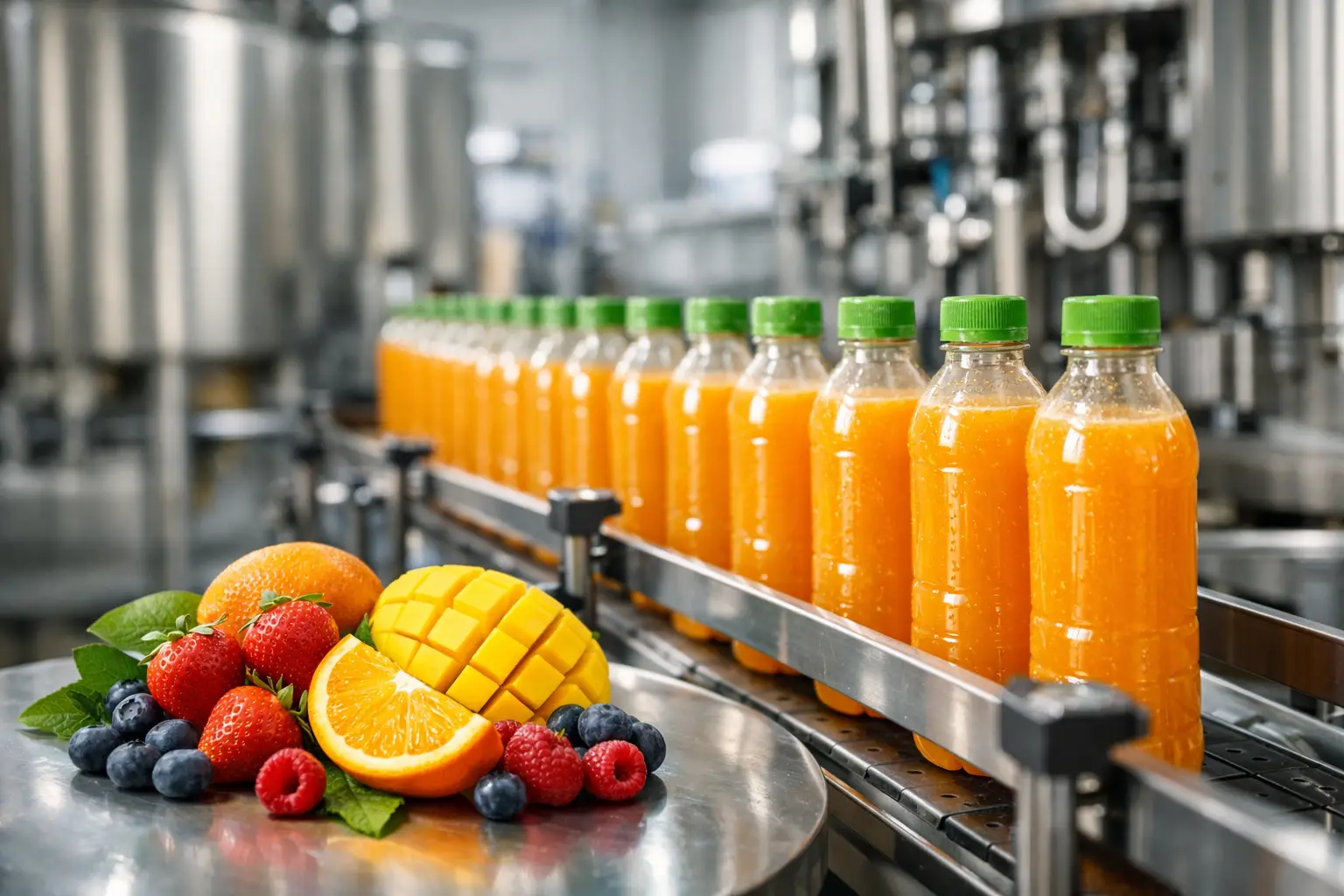
A beverage can look clean on the label and still fail where it matters most – flavor consistency, shelf life, line efficiency, and market readiness. That is the central challenge in real fruit beverage manufacturing. Using actual fruit purées, juices, concentrates, and natural extracts raises the standard for product quality, but it also raises the level of technical discipline required to produce at scale.
For buyers, distributors, and brand owners, the appeal is obvious. Real fruit supports stronger sensory credibility, cleaner positioning, and a more defensible premium story. But real fruit also introduces variability, microbiological sensitivity, supply pressure, and formulation complexity. The difference between a product that performs and one that struggles is usually not the fruit itself. It is the manufacturing system behind it.
What real fruit beverage manufacturing really demands
Real fruit beverage manufacturing is not just a procurement decision. It is a full production model that starts with ingredient selection and carries through formulation, processing, filling, compliance, and distribution. Every step affects the finished drink.
Fruit brings natural acids, sugars, pulp, color, aroma compounds, and suspended solids. Those characteristics can create a more authentic drinking experience, but they also affect viscosity, settling behavior, thermal stability, and package performance. A beverage built with lemon juice behaves differently from one made with mango purée. Berry blends can be highly sensitive to oxidation. Citrus oils can shift flavor perception over time. Tropical fruits often require a different balance of stabilization and process controls than lighter juice-based drinks.
This is why manufacturing decisions cannot be separated from brand strategy. If a product is positioned as all-natural, no-compromise, and fruit-forward, the operation has to support that claim with repeatable execution.
Ingredient quality sets the ceiling
The highest-performing production line cannot fix weak raw materials. In real fruit beverage manufacturing, the incoming fruit ingredient sets the ceiling for flavor, appearance, and finished product credibility.
That starts with source format. NFC juice, concentrate, purée, and comminuted fruit each bring different cost structures and technical implications. NFC may support a fresher profile, but it can compress shelf-life options and increase cold-chain sensitivity. Concentrates improve freight efficiency and can help with standardization, but reconstitution accuracy becomes critical. Purées create richer texture and stronger fruit identity, yet they often increase processing complexity and package sediment risk.
Seasonality matters as well. Fruit is an agricultural input, not a static commodity. Brix, acidity, color, and aroma can shift by harvest, origin, and crop year. Manufacturers that work successfully with real fruit build systems for standardization, not assumptions of sameness. That means tighter specifications, validated supplier approvals, incoming testing, and formulation adjustments that preserve target taste without compromising the label.
For commercial buyers, this is where manufacturing credibility becomes visible. A supplier that can secure quality fruit inputs consistently across regions and production runs is in a much stronger position to support national or international distribution.
Formulation is where clean label meets production reality
A concept can taste excellent in a benchtop sample and still fail in production. Real fruit intensifies that risk because what works in a small batch may not remain stable through thermal processing, filling, transport, and shelf life.
Formulation work has to account for acid balance, sweetness profile, pulp load, mouthfeel, preservative strategy, and compatibility with vitamins, functional actives, or alcohol if relevant. Some fruit systems work well with hot fill. Others may require aseptic processing, tunnel pasteurization, or a refrigerated route to market. There is no single best method. It depends on the product, package, channel, and target shelf life.
This is also where trade-offs become real. A shorter ingredient deck may strengthen market appeal, but it can narrow processing flexibility. A high-fruit-content beverage can justify premium positioning, but it may reduce fill-line speed or increase cost per case. Functional ingredients can add value, but they may interact with fruit acids or affect clarity and taste. Good manufacturing is not about forcing one ideal. It is about making the right technical choices for the commercial objective.
Stability is not optional
Consumers accept natural variation to a point. They do not accept a drink that separates excessively, browns in the bottle, or tastes different from one purchase to the next.
Stability work in real fruit beverage manufacturing includes emulsion management, pulp suspension, oxygen control, pH targeting, and packaging compatibility. In some products, homogenization is essential. In others, it can damage the desired texture or flavor release. Even a strong formula can lose ground if headspace oxygen, light exposure, or temperature abuse are not properly managed.
Processing must protect both flavor and throughput
The pressure in commercial beverage production is clear: maintain product integrity without slowing output to the point that margins collapse. Real fruit makes that balance more demanding.
Heat treatment has to achieve microbiological safety while preserving color and flavor as much as possible. Excessive thermal exposure can flatten fresh notes, darken delicate fruit systems, and shift aroma balance. Underprocessing creates an obvious safety and shelf-life problem. That is why process validation matters. It is not enough to have equipment. The line has to be tuned to the product.
High-speed automated production can absolutely support premium fruit beverages, but only when the process design is disciplined. Fruit particulates affect pumps, valves, filters, and fillers. Viscosity influences flow behavior. Cleaning protocols must account for sugar load and organic residues. Downtime, product loss, and inconsistent fills often trace back to weak alignment between formula and line capability.
For brands planning growth, this point is critical. A beverage that can be made only in limited artisan runs may be appealing at launch, but it becomes a liability when chain placement or export volume arrives. Scale should not dilute quality, but quality also cannot depend on low-volume conditions.
Packaging decisions shape product performance
Package choice is not just a branding exercise. It changes the manufacturing path and the product’s risk profile.
PET, glass, cans, and multilayer formats each have strengths. Glass supports premium presentation and strong flavor protection, but it adds weight and logistics cost. PET offers flexibility and broad market familiarity, though oxygen transmission and heat tolerance must be considered carefully. Cans are increasingly relevant for functional and sparkling formats, but acidity, lining compatibility, and pulp behavior require technical review. The right format depends on channel strategy as much as aesthetics.
On-premise and off-premise needs can also differ. A cocktail mixer built with real fruit may need one packaging strategy for hospitality and another for retail. A health-oriented fruit beverage for convenience channels may prioritize portability and shelf stability over visual display of pulp. Manufacturing planning has to start with those realities, not treat them as late-stage adjustments.
Compliance and documentation protect the brand
Real fruit beverage manufacturing carries a stronger burden of proof than many new entrants expect. Label claims, ingredient declarations, nutritional panels, HACCP controls, lot traceability, and market-specific regulations all need to align.
This becomes more demanding when products cross borders or move through multiple channels. Importers and large retail buyers want consistency, but they also want documentation that supports it. Country-of-origin records, allergen controls, microbial standards, and packaging compliance are not side issues. They are part of the product’s commercial viability.
For founders and private-label operators, experienced manufacturing support can remove a major source of risk. The faster route is not skipping compliance work. It is building it into the process from the start.
What buyers and brand owners should look for
If you are evaluating a manufacturing partner, real fruit capability should be judged on more than sample quality. The real test is whether the operation can protect product standards under commercial pressure.
Look for evidence of ingredient sourcing discipline, validated processing methods, pilot-to-production consistency, and packaging flexibility. Ask how the manufacturer manages crop variation, shelf-life testing, and line compatibility for pulp or high-acid products. Capacity matters, but capacity without formulation and quality control depth is not enough.
This is where a company with heritage, multi-region production reach, and category range has an advantage. Experience across natural cocktails, sports drinks, energy beverages, and functional concepts creates a stronger operating base for real-fruit development because the team has already worked through the practical trade-offs between taste, stability, compliance, and scale.
Why scale matters in real fruit beverage manufacturing
Real fruit beverage manufacturing works best when quality systems and production systems are built together. That is what allows a beverage to stay true to its fruit identity while meeting the demands of distribution, replenishment, and margin control.
The market has moved past surface-level natural claims. Buyers want proof. Consumers want authenticity they can taste. Brand owners want speed without shortcuts. Meeting all three requires more than a good idea and a clean label. It requires disciplined manufacturing, reliable sourcing, and a production platform designed to deliver real ingredients at commercial volume.
That is the standard worth building to – because in this category, the product only earns trust when the process behind it holds up every time.

No responses yet