
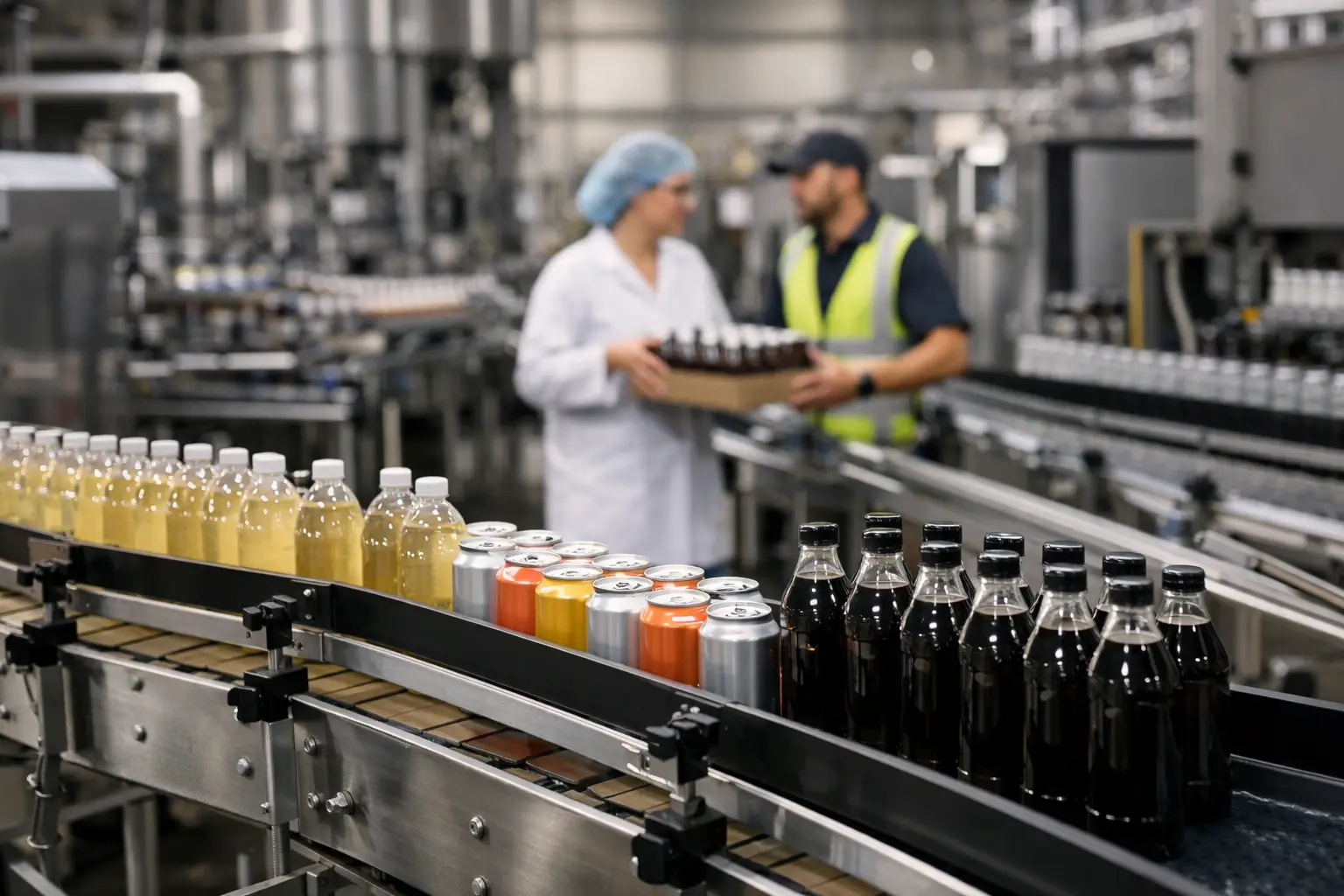
A beverage brand usually finds out what manufacturing really means the first time demand outpaces a pilot run. What looked manageable at small volume suddenly turns into sourcing pressure, fill-line constraints, label compliance issues, and missed delivery windows. That is where beverage co packing services stop being a convenience and start becoming a growth requirement.
For founders, private-label operators, and procurement teams, the question is not simply who can fill cans or bottles. The real question is who can protect product integrity while producing at commercial scale, across the right formats, with the quality discipline your customers expect. In beverage, a weak manufacturing partner does not just create delays. It puts brand trust at risk.
What beverage co packing services actually include
At a basic level, beverage co packing services cover the production and packaging of drinks by a third-party manufacturer. In practice, the scope can be much broader. A serious co-packing partner may support formulation refinement, ingredient sourcing, regulatory review, pilot runs, packaging selection, production scheduling, quality control, and finished goods handling.
That distinction matters. Some providers are essentially toll fillers. They run your approved formula, package it, and move on. Others operate as end-to-end partners that can help take a beverage from concept to shelf-ready production. Which model fits depends on your stage, your internal team, and how much technical and operational support you need.
For an emerging brand, wider support can reduce launch risk. For an established company with an experienced operations team, a more specialized production partner may be enough. Neither approach is automatically better. The right fit comes down to control, speed, and the complexity of the product.
Why beverage co packing services matter for growth
The biggest advantage of co-packing is obvious – you avoid the cost and burden of building your own facility. Beverage manufacturing is capital intensive, compliance heavy, and unforgiving when processes are inconsistent. Equipment, labor, certifications, QA systems, and raw material planning all require constant oversight.
But the deeper value is execution. Good co-packers give brands access to production discipline that would be difficult to build quickly on their own. That includes validated processes, trained operators, tested packaging systems, and the ability to move from smaller runs to larger production volumes without rebuilding the entire supply chain.
This is especially relevant for natural, functional, and clean-label beverages. Products made with real ingredients often bring added complexity. They can be more sensitive to heat, ingredient interaction, shelf-life variation, and sensory consistency. A co-packer that understands those realities can help prevent costly reformulations and quality failures.
For channel partners and beverage buyers, manufacturing strength matters just as much as brand positioning. A product can have a compelling concept and strong demand pull, but if supply is inconsistent, the commercial opportunity weakens fast. Reliable co-packing supports continuity, not just output.
What to look for in a co-packing partner
Capacity is the first screen, but it should not be the only one. A facility may have available line time and still be a poor fit for your product. Beverage production has too many variables for a simple volume-based decision.
Start with product compatibility. Can the manufacturer handle your beverage type, whether that means cocktails, sports drinks, functional blends, energy beverages, or other non-alcoholic formulations? Can they support your preferred format, such as cans, glass, PET, or multipack configurations? Format flexibility is not a small detail. It affects cost, channel strategy, and shelf presentation.
Then look at quality systems. A co-packer should be able to speak clearly about ingredient controls, batch consistency, sanitation standards, traceability, testing protocols, and regulatory compliance. If the answers are vague, the risk is real. In this category, confidence should come from process, not promises.
Supply chain reach also matters. Brands serving multiple markets often need more than a single domestic production point. Manufacturing flexibility across regions can reduce freight complexity, improve lead times, and create a buffer when one market faces sourcing or logistics disruption. That kind of footprint becomes more valuable as a brand grows.
Commercial alignment is another factor buyers often underestimate. Some co-packers are structured for high-volume mature brands and have little patience for development-stage complexity. Others are set up for niche runs but cannot support serious growth. The best partnerships are built around shared expectations on run size, forecasting, quality standards, and speed to market.
The trade-offs behind cost, speed, and control
Every beverage company wants low cost, fast production, and tight control. In reality, there is usually tension between those goals.
Lower-cost manufacturing may come with higher minimums, less schedule flexibility, or fewer options for custom processes. Faster timelines may require compromises in packaging availability or ingredient sourcing. Greater brand control often means more internal management, more technical oversight, and sometimes higher production cost.
This is why co-packer selection should not be based on price per unit alone. A quote can look attractive until you account for waste, delays, reformulation risk, freight inefficiency, or the cost of quality failures in the market. The cheapest run is not the cheapest outcome.
For premium beverage brands, this point is critical. If your market position depends on purity, flavor consistency, and clean-label credibility, manufacturing shortcuts can damage more than a single production cycle. They can erode the core value of the brand.
Beverage co packing services for natural and functional drinks
Natural and performance-oriented beverages require tighter production discipline than many standard formulas. Real fruit inputs, botanical systems, vitamins, minerals, plant extracts, and active ingredients can behave differently under heat, mixing, and storage conditions. Small process changes can alter taste, appearance, or stability.
That means beverage co packing services for these categories need to go beyond filling capability. The right partner should understand how formulation interacts with process design. They should know when an ingredient system may challenge shelf life, when a package type may affect product protection, and when a scale-up run may produce a different result than the bench sample.
This is where experience matters. Heritage in beverage manufacturing is not just a branding point. It reflects repeated exposure to formulation problems, packaging variables, and production pressures that newer operators may not be equipped to manage. Strong co-packers bring that discipline to each stage of commercialization.
For brands entering retail, foodservice, or international markets, there is also the issue of specification management. Product standards must remain consistent while volumes increase and distribution expands. That requires process control, documentation, and the ability to execute without compromise.
When a turnkey model makes sense
Not every brand needs a turnkey partner, but many benefit from one. If your team is lean, your formula is still evolving, or your launch schedule is tight, a manufacturer that can support development through final pack-out can reduce handoff errors and keep decision-making tighter.
A turnkey model is particularly useful when you need one partner to coordinate formulation support, sourcing, compliance review, packaging procurement, and production planning. That can simplify communication and shorten the path from concept to first commercial run.
The trade-off is that you need clear governance. The more responsibilities a partner takes on, the more important it is to define specs, approvals, cost assumptions, and quality benchmarks in advance. A turnkey relationship works best when both sides are disciplined.
This is one reason companies such as UNC One Corp. are positioned well in the market. Brands looking for natural beverage expertise often need more than excess line capacity. They need manufacturing competence, clean-label understanding, and the ability to scale across regions without losing product standards.
Choosing for the next stage, not just the next run
A co-packing decision should support where your beverage business is going, not only what it needs this quarter. If you expect channel expansion, SKU growth, or international demand, your production partner needs the systems and footprint to keep up. Changing manufacturers later can be expensive, disruptive, and risky for product consistency.
That does not mean choosing the largest possible operator every time. It means choosing a partner whose quality standards, technical capability, and production model fit your category and growth path. The right co-packer helps protect the formula, the schedule, and the reputation behind the label.
In beverage, scale only matters when quality survives it. The strongest manufacturing partnerships are built on that understanding from the start.

No responses yet